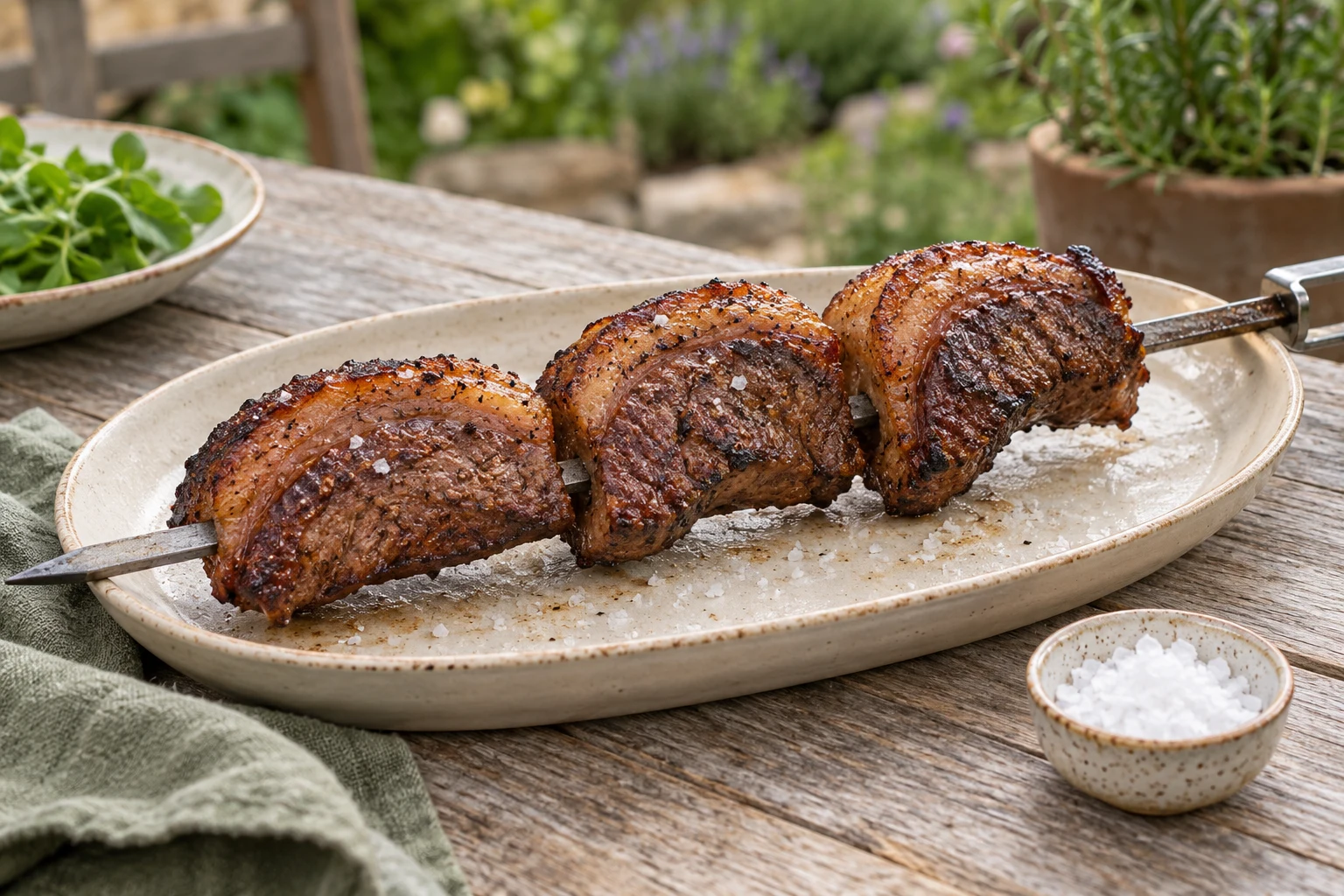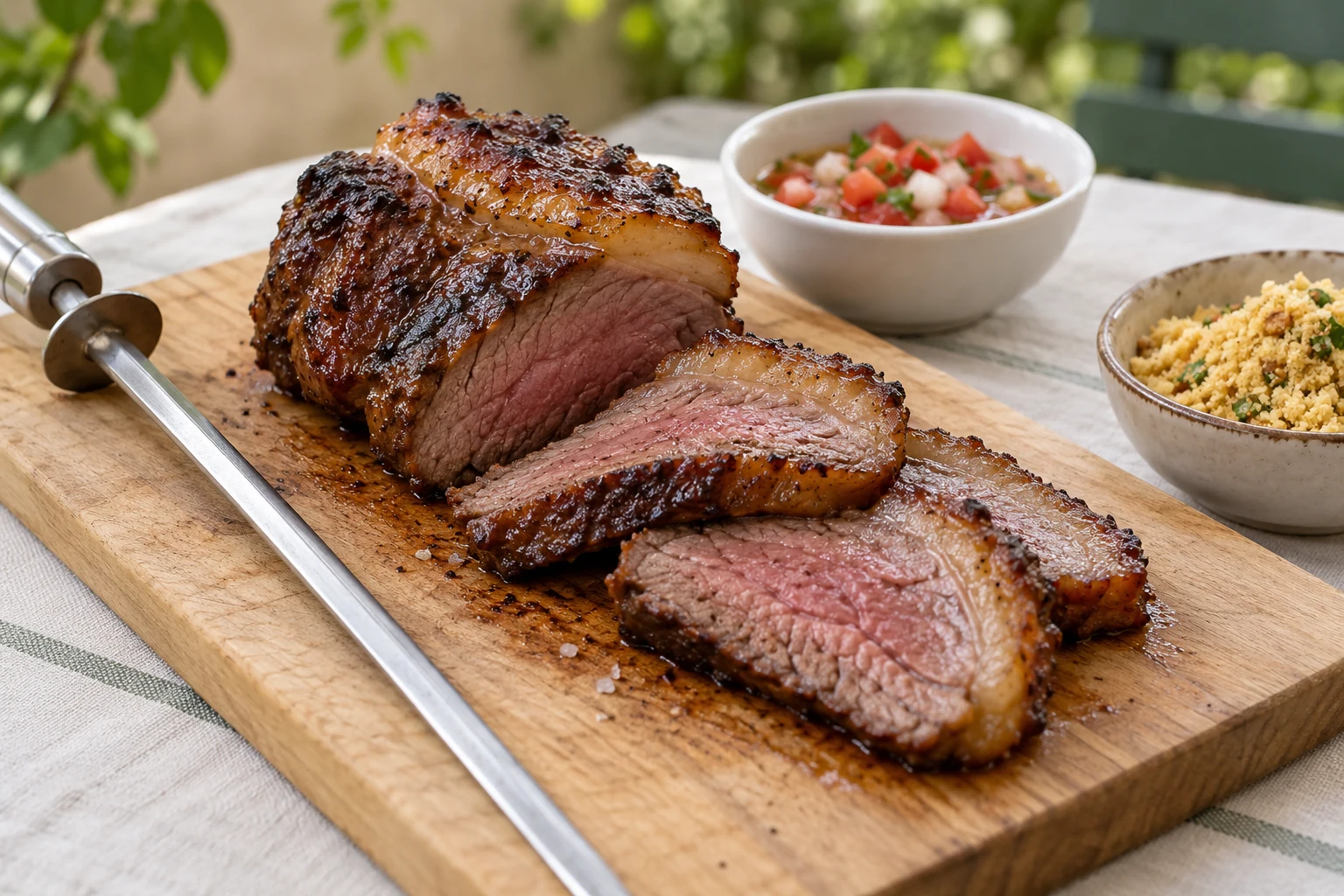
Brazilian churrasco is often introduced through its spectacle: skewers, open heat, and meat sliced at the table. The more useful lesson for a home cook is simpler. The cook manages distance from the fire, seasons the food without hiding it, cooks in stages, and serves when each piece is ready. A backyard grill will not reproduce every regional practice or social setting, so this guide treats the method as a respectful home adaptation rather than a claim to authenticity.
Start with the fire, not the sauce
Skewers work best when the fire has a stable cooking zone. Build or light the fuel early enough that the first flames settle and the cooking heat is predictable. Tall flames can blacken the outside before the centre is ready. A bed of hot coals gives a wider and calmer zone; a two-level arrangement lets you move a skewer away from direct heat when fat begins to drip.
Keep a cooler section available. Churrasco is served in rounds, and that rhythm is easier when food can pause without being abandoned over the hottest part of the grill. Use long-handled tools, stable heatproof surfaces, and clear space around the grill. Open-fire cooking still requires the ordinary precautions of any outdoor grill: distance from structures, attention to wind, and no indoor use.
Choose cuts that suit skewers
The cut determines whether a skewer is a help or a burden. Pieces should be large enough to stay moist and firm enough to turn without collapsing. Fat can baste a piece as it cooks, but large exterior fat pockets can also cause flare-ups. Trim loose edges that will burn, while keeping enough structure for the meat to hold on the skewer.
For a home cook, the most important distinction is not memorising a list of Brazilian names. It is matching thickness to heat. Thin slices need quick cooking and close attention. Cubes and thicker pieces need enough time for the surface to colour without leaving the centre behind. Chicken and ground-meat mixtures need particular care because colour is not a reliable safety test.
If using wooden skewers, follow the product instructions and make sure they are suitable for the heat. Metal skewers become extremely hot and need a safe resting place. Arrange pieces with a small gap so heat can circulate. Crowding creates a wet surface and makes turning awkward.
Keep the seasoning clear
Simple seasoning is not the same as careless seasoning. Salt needs time to dissolve and spread, while a heavy wet marinade can drip into the fire and obscure the taste of the meat. Pat marinated pieces dry enough to limit uncontrolled flare-ups. Never reuse a marinade that has touched raw meat as a finishing sauce unless it has been handled and cooked safely.
The right question is what the fire can add. A lightly seasoned cut can show browning, smoke, and rendered fat. A sugary glaze belongs late in the cook because it can burn before the meat is done. A sauce served at the table gives the cook more control than a thick coating applied at the beginning.
Cook in rounds and control distance
Place the skewer over the heat with enough room to turn it safely. Watch the underside before turning instead of rotating constantly. A crust needs time to set. When fat drips and the fire jumps, move the skewer to the cooler side rather than fighting the flame with repeated flips. Once the flare-up settles, return the food to finish.
Distance is a practical control. Move a skewer closer when the surface needs colour; move it farther away when the outside is advancing faster than the centre. On a gas grill, reduce a burner or use an unlit zone. On charcoal, use the layout of the coals and the lid to make the same kind of adjustment. The vocabulary may change with the equipment, but the decision is the same: regulate the rate at which the surface and centre cook.
Use a thermometer for the safety decision. FoodSafety.gov and USDA FSIS guidance should govern the finished internal temperature for the specific food, especially poultry and ground meat. Insert the probe into the thickest piece without touching the skewer or grate. If pieces vary in size, check the largest and the food with the highest safety risk rather than assuming the whole skewer is ready because one edge is browned.
Avoid the common home adaptation mistakes
The first mistake is using a fire that is too aggressive. Churrasco is not improved by constant flames. The second is loading a skewer with pieces that need different cooking times. Mixing thin vegetables, thick beef, and chicken on one skewer makes every doneness decision harder. Use separate skewers or cook in stages.
The third mistake is treating the serving rhythm as decoration. If everything is cooked at once, food cools while the cook is still working. Keep finished pieces on a clean platter, protect hot food from raw-food contact, and bring out small rounds when they are ready. A simple side, a bright acid element, and a sauce can be prepared before the fire so the grill is not also responsible for the whole meal.
Build a respectful version at home
A home cook can borrow the useful mechanics without presenting a simplified backyard meal as the complete tradition. Say what has been adapted: the equipment, cut, seasoning, serving order, or fire arrangement. The point is not to imitate a photograph. It is to understand how a cooking style uses heat, portioning, and timing to make a meal social and manageable.
After the cook, record the cut thickness, fuel, distance, turning point, and internal temperature. If the surface was dark before the centre was ready, lower the heat or increase distance next time. If the meat was pale and wet, improve drying, spacing, or preheat. Those observations turn skewers from a novelty into a repeatable fire method.
Sources
- FoodSafety.gov Safe Minimum Internal Temperatures: https://www.foodsafety.gov/food-safety-charts/safe-minimum-internal-temperatures
- USDA FSIS Safe Temperature Chart: https://www.fsis.usda.gov/food-safety/safe-food-handling-and-preparation/food-safety-basics/safe-temperature-chart
- FoodSafety.gov How to Grill Safely: https://www.foodsafety.gov/blog/how-grill-safely-summer